
Download the app


© 2026. The Purpl Co Limited. All rights reserved.


Download the app
© 2026. The Purpl Co Limited. All rights reserved.
18 min read
Written by
Georgina, Founder of Purpl
Published on
January 16, 2025
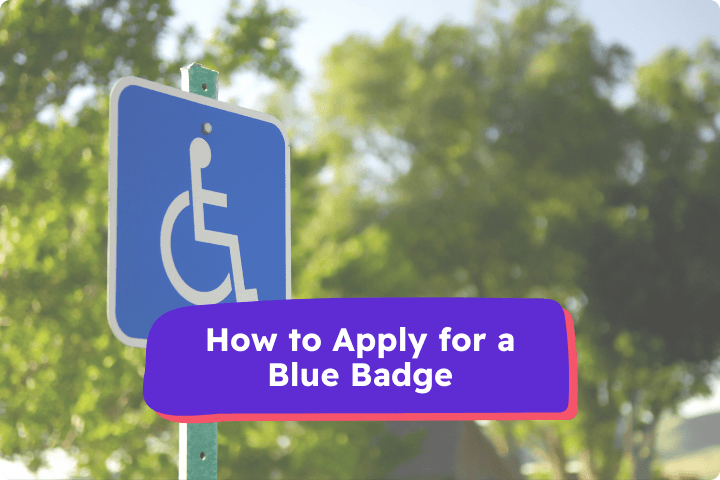
The Blue Badge scheme is a cornerstone of accessibility in the UK, designed to provide parking privileges for people with disabilities or health conditions that make walking difficult. Our Purpl guide looks at the Blue Badge scheme, explaining its purpose, eligibility criteria, application process and benefits.
I hesitated to get a Blue Badge when my walking first worsened, feeling I wasn’t ‘disabled enough.’ But parking closer made life easier, preventing my legs from giving out. Now I mostly use a wheelchair, but the badge gives me some independence, letting me reach places on my own and rest when needed.
Georgina, Founder of Purpl
The Blue Badge scheme was introduced in 1971 to improve the mobility of disabled people in the UK by allowing them to park closer to their destinations. This can be a lifeline for people who face barriers to transportation, enabling them to maintain independence, access essential services, and participate in social activities.
The Blue Badge is recognised across the UK, including England, Scotland, Wales, and Northern Ireland, and even extends to certain countries in the European Union, ensuring that Blue Badge holders can benefit from improved access wherever they travel.
The Blue Badge is for your use and benefit only. It must only be displayed if you are travelling in a vehicle as a driver or passenger, or if someone is collecting you or dropping you off and needs to park at the place where you are being collected or dropped.
Did you know you can use a Blue Badge in any vehicle, so if a friend is taking you out they can park in a disabled space as long as you are getting out of the car.
Georgina’s Disabled Tips
Some disabled people will automatically be eligible for a Blue Badge and will not need to provide further evidence, if you don’t meet the criteria for automatic eligibility, you may still be able to receive a Blue Badge based on other factors.
Disabled people who meet the following criteria will be automatically eligible for a Blue Badge as long as they are over the age of 3. Please note you will need to provide your documentation with your disability award information as part of the application process.
If you don’t meet the automatic criteria you may still qualify for a Blue Badge, this will be dependent on your local council and is not guaranteed. If you have a permanent and substantial disability that significantly affects you ability to walk or you struggle with extreme anxiety, you may be able to get a Blue Badge.
Each council is different, and you will be assessed on an individual basis. You may qualify for a Blue Badge based on the following examples:
As mentioned, local councils assess these applications on a case-by-case basis, often requiring medical evidence and, in some cases, an independent mobility assessment. To find your local council, you can search on this website with your postcode.
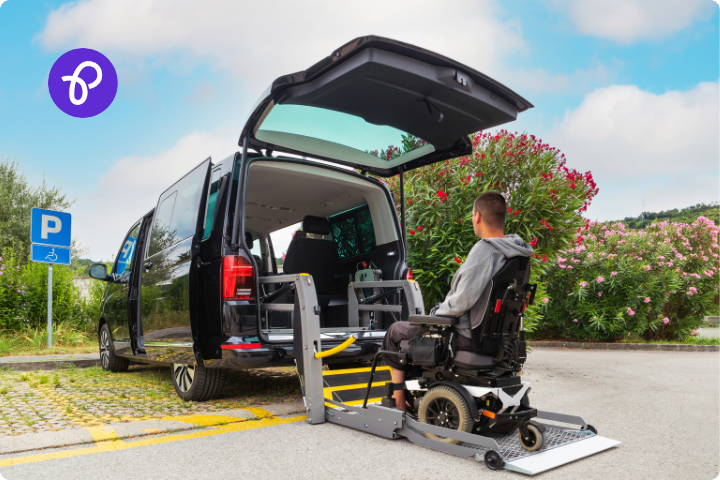
The council will need to assess your application before making a decision and there are several steps that you will need to go through when applying for a Blue Badge, this may be slightly different depending on where you live and how your local council manages the process.
The application is more complicated if you’re not automatically eligible, as you will need to make a case as to why you believe you should have a Blue Badge, this means providing as much evidence as you can. You may need some help to guide you through the process, if so, please contact your nearest Citizens Advice who will be able to assist you.
This is a quick overview of what is required, we will then go into each section in more detail and provide you with further information that may be beneficial to you:
If you are a disabled person in the UK looking to apply for a Blue Badge, you will need to provide the following on your application:
You will then need to provide evidence to demonstrate that you meet the automatic criteria. If you don’t meet the automatic criteria you will be asked further questions and may need to provide extra evidence to help with your application.
The evidence you need to provide for your Blue Badge application will depend on whether you meet the automatic criteria or not. Below is the information you will need to provide to your local council when applying for a Blue Badge in the UK.
If you are unable to upload your documents at the time of your application, you will need to still send them to your local council. Find out how to contact your local council.
If you meet the criteria for automatic eligibility for a Blue Badge you will still need to provide proof of your disability benefit award details, below is the detail required.
Personal Independence Payment (PIP)
You will need to know the scores from your mobility assessment along with your award end date (if applicable). You will also be asked to provide proof of your PIP award including the following pages from your most recent DWP award letter:
Disability Living Allowance (DLA)
You will need to know which rate of the mobility component you receive along with your award end date (if applicable). You will also be asked to provide proof of your DLA award including the following pages from your most recent DWP award letter:
Armed Forces Compensation Scheme
You will be asked to provide proof of the Armed Forces Compensation Scheme benefit. This will be the most recent letter you received from the Ministry of Defence, which clearly shows:
War Pensioners’ Mobility Scheme
You will be asked to provide proof of your War Pensioners’ Mobility Scheme benefit. This will be the most recent letter from the Ministry of Defence, which clearly shows:
If you are applying for a Blue Badge and you do not meet the automatic criteria your application will need to be assessed by your local council. To help the council assess your application, you will be asked to provide additional information depending on the answers you give during the eligibility part of the application form.
If you cannot walk or find walking difficult or you have a non-visible (hidden) condition, you will be asked to provide additional details of:
You will then be asked if you want to upload supporting documents, these could be copies of your prescriptions, copies of any diagnosis letters or other letters from your medical team that relate to your condition. If you are unable to upload your documents at the time of your application, you will need to still send them to your local council. Find out how to contact your local council.
For those individuals who cannot walk or find walking difficult, you will also be asked questions around how your condition affects your ability to walk.
For those individuals who have a non-visible (hidden) condition, you will also be asked questions around how journeys between your vehicle and your destination are impacted by your condition.
Please note that it may take a long time for your application to be processed, especially if you are not automatically eligible. We recommend contacting your council if you haven’t heard back from them within 12 weeks.
Some individuals may be asked to do a mobility assessment. A health professional will look at your ability to carry out a range of different mobility activities. They will then inform your council whether they think your health condition or disability limits your ability to move around enough for you to require a blue badge. You also might be asked to send in additional information or be asked to have a conversation with a member of the council.
You will receive an email or a letter letting you know if your application was approved. If you were refused a Blue Badge, you can ask your council to reconsider their decision. The decision letter you receive will tell you how to ask for a review and what the time limit is.
If your application for a Blue Badge is declined, it can be disheartening, but there are steps you can take to appeal the decision or strengthen a new application. You can ask your council to reconsider their decision. The decision letter from the council will tell you how to ask for a review and what the time limit is.
It is worth noting that all councils have slightly different review processes, some will include a form with your letter to be completed and returned, and others will ask you to write your own letter. Make sure you follow the instructions they provide. Citizens Advice has advice on how to write your review request letter for those who need support.
If a local authority decides that you do not qualify for a Blue Badge, you can ask for another review of the decision within 28 days of receiving it.
Being turned down for a Blue Badge can feel like a setback, but with persistence and the right support, you may still achieve a positive outcome. The appeals process and reapplication provide opportunities to ensure that your needs are properly considered.
Your Blue Badge will last for three years. The council will normally contact you to let you know your Blue Badge will be expiring soon and that you need to reapply. We recommend that you reapply for your new Blue Badge 6-8 weeks before it runs out in case there are any delays.
You can reapply for your Blue Badge on the government website.
You must use the Blue Badge properly otherwise it may be taken away from you. The Blue Badge is for your use only, you must never allow friends or family to use your Blue Badge. It is a criminal offence for you or anyone else to misuse the Blue Badge. Doing so could lead to a £1,000 fine and confiscation of the Blue Badge.
If you are using the Blue Badge as a passenger, it is your responsibility to make sure that the driver is aware of all the rules. Make sure you have read the guidance rules for using a Blue Badge.
You must display your Blue Badge in a place where it can be clearly read from outside the vehicle. The front of the Blue Badge should face upwards, showing the hologram, the side with your photograph should not be visible.
You must also ensure that the details on the front of the Blue Badge remain legible. If they become unreadable through fading or wear and tear, you must return the Blue Badge to your local council so they can issue you with a new one. Displaying a badge that is illegible may result in a parking fine.
Make sure you are not displaying a Blue Badge that has expired as it will not be valid which may result in your receiving a parking ticket and a fine.
Incorrect display of the Blue Badge may result in a parking fine or a penalty charge notice.
When you receive your Blue Badge you will also be provided with a Parking Clock, this is used in certain situations for example, when you park on yellow lines or in other places where there is a time restriction. You will need to display your time of arrival on the Parking Clock The clock should be sent to you together with the Blue Badge and a guidance booklet. If you didn’t receive one you can contact your council and ask them to send you one.
If you need to display your Parking Clock, make sure you place it on your vehicle’s dashboard or facia panel, so that the time can be seen clearly through the front windscreen next to your Blue Badge. The clock should be set to show the quarter hour period during which you arrived.
The Blue Badge is not a licence to park anywhere, you must not park in places where it could endanger, inconvenience or obstruct pedestrians or other road users. When you receive your Blue Badge you will also receive a guidance booklet with it – this will give you details on where you can park as well as where you can’t park. Make sure you read it thoroughly to avoid fines or confiscation of your Blue Badge.
The way a Blue Badge can be used differs depending on where you live:
These are the parking concessions available to you as a Blue Badge holder in England:
As a Blue Badge holder, you may park on single or double yellow lines for up to 3 hours, but in general not where there are restrictions on loading or unloading – as indicated by yellow kerb dashes and / or signs on plates or on yellow lines in off-street car parks. You may wish to check whether a particular local council has chosen to exempt Blue Badge holders from this restriction.
You must display your Blue Badge and the Parking Clock showing the quarter hour period during which you arrived. You must wait for at least one hour after a previous period of parking before you can park the same vehicle in the same road or part of a road on the same day.
Typically Blue Badge holders may park for free and for as long as they need to but this may depend on your local council so always check first. You must display the Blue Badge.
You may park for free. Unless signs say otherwise, you may also park without time limit. You must display the Blue Badge (and the Parking Clock if the bay is time limited).
Did you know you can park in a regular parking space if there are no disabled bays free. Make sure you display your Blue Badge correctly and if it is a car park where disabled people can park for free then you won’t need to pay either.
Georgina’s Disability Tips
There are a number of restrictions and local parking schemes which you need to be aware of. Here is a list of those places and the parking restrictions in force. If in doubt, ask the relevant council.
Such as supermarket, hospital or local council car parks. Off-street car park operators should provide parking spaces for disabled people. However, it is up to the car park owner to decide whether badge holders can park free of charge. Do not assume you can always park for free. In some places, the local council will offer free parking for disabled people across all the council run car parks.
For the London boroughs of Kensington & Chelsea, the City of Westminster, the City of London and part of the London Borough of Camden see Parking in Central London below for further details.
Check local signs for information.
Where all motorists can park for free but only for a limited time. Blue Badge holders may park for free and generally without time limit. However, if signs show there is also a time limit for Blue Badge holders, you must comply with the time limit shown and display your parking clock.
Do not park unless you have permission from the owner.
Red routes are major roads in Greater London which are marked with a single or double red line. Transport for London has general information on concessions for Blue Badge holders on roads that have priority (red) route controls. You can obtain this information by ringing them on 0845 305 1234 or by visiting their website. There are a small number of red routes outside of London. Contact the relevant local council for advice on parking restrictions on these routes.
There are some places where you absolutely cannot park even if you have a Blue Badge, these include:

You should always tell your local council if something changes, such as:
You will also be able to update your details on GOV.UK.
The Blue Badge provides disabled people with range of benefits, significantly improving the quality of life for you and your family. The key benefits of having a Blue Badge include:
As a Blue Badge holder you can park closer to essential destinations such as shops, hospitals, and workplaces, minimising the physical strain of walking long distances.
Having the ability to park in convenient locations reduces stress, particularly in busy areas where parking is limited.
By easing access to social and recreational activities, the Blue Badge helps combat isolation and promotes community engagement. For many disabled individuals, the Blue Badge represents a vital tool for maintaining independence and participating fully in society. It empowers them to pursue education, employment, and leisure activities without the constant worry of parking accessibility.
Not only can you use your Blue Badge as evidence of your disability to join Purpl and access disabled discounts you can also use it to get other concessions for example discounts on ferry crossings and free carer places when out and about. It is always worth asking if they do a discount if you have a Blue Badge.
For more information on the benefits of a disabled blue badge, see our TikTok video below:
Despite its many benefits, the Blue Badge scheme is not without its challenges, here are some of the most common problems that disabled people in the UK encounter:
Inconsistent Eligibility Assessments
The discretionary application process can lead to inconsistencies, with some councils approving applications more readily than others. This has raised concerns about fairness and the need for standardised guidelines.
Limited Availability of Accessible Parking
Despite having a Blue Badge, many disabled people struggle to find available parking spaces, particularly in urban areas.
Public Perception
There are misconceptions about the scheme, with some members of the public questioning the validity of certain badge holders’ disabilities. Invisible disabilities, such as chronic pain or mental health conditions, are particularly prone to skepticism, and this can cause a lot of anxiety with the use of the Blue Badge.
The Blue Badge scheme has evolved over the years to address changing societal needs and to enhance inclusivity. The biggest developments include:
Inclusion of Invisible Disabilities
In 2019, the scheme was expanded to include individuals with non-visible disabilities such as autism, anxiety disorders, and chronic pain conditions. This was a landmark change that recognised the diverse ways in which disabilities can impact mobility.
Digital Modernisation
Many councils now offer online application and renewal processes, making it easier for individuals to access the scheme. Efforts are also underway to improve the digital verification of Blue Badges to reduce fraud.
Public Awareness Campaigns
Campaigns have been launched to educate the public about the Blue Badge scheme, aiming to reduce stigma and improve understanding of its purpose.
If you’re disabled you may be exempt from vehicle tax, or qualify for a reduction. We have a Purpl guide where you can find out if you qualify for vehicle tax exemption. You could also get Toll concessions on rivers, bridges and tunnels.
And of course, if you have a Blue Badge, you can join Purpl and enjoy massive savings, disabled discounts, offers and deals from all your favourite brands!
The Blue Badge scheme is a vital lifeline for people in the UK, offering improved access, independence, and quality of life. As society continues to prioritise inclusivity and accessibility, the Blue Badge scheme serves as a reminder of the importance of removing barriers and empowering all individuals to lead fulfilling lives.
For those who rely on it, the Blue Badge is more than just a parking permit, it’s a symbol of equality and opportunity.

Georgina is the founder of Purpl, a platform dedicated to helping disabled people save money through exclusive discounts. Living with Multiple Sclerosis (MS) and ADHD, she understands firsthand the financial challenges of living with a disability. Her mission is to work with brands to secure discounts that ease the cost of essential products, services, and everyday expenses for the disabled community.
As an ambulatory wheelchair user, Georgina knows how it feels to lose independence due to a disability. She is passionate about holistic therapies and diet to manage inflammation and stay as healthy as possible. Her goal is to make Purpl an essential resource for disabled people, offering practical support, advice, and financial relief.
Beyond Purpl, Georgina has a long-term vision to launch a foundation providing grants for disabled people who need extra financial support.
She lives in Hampshire, UK, with her husband, son, three stepsons, two cats, and a friendly Labrador. A keen reader, Lego enthusiast, and family-focused person, Georgina is committed to building a supportive, inclusive community for those navigating life with a disability.
Follow @Purpldiscounts for the latest disability discounts, financial advice, and accessibility resources.
Yes, possibly. In 2019, the scheme was expanded to include people with non-visible disabilities such as autism, anxiety disorders, and chronic pain conditions. Local councils assess these applications on a case-by-case basis, often requiring detailed medical evidence and, in some cases, an independent mobility assessment.
The badge is for your use and benefit only. It must only be displayed if you are travelling in the vehicle as a driver or passenger, or if someone is collecting you or dropping you off and needs to park at the place where you are being collected or dropped.
You can use your UK Blue Badge when travelling in some EU countries, Liechtenstein, Norway and Switzerland. Check which countries accept a UK Blue Badge. But it is advised to check as parking concessions vary in each country.
There are no current arrangements for you to use the badge outside the European Union, in countries such as the USA, Canada, Australia or New Zealand, although they may be prepared to recognise the Blue Badge. It is advised that you to check what concessions are available before travelling to non-EU countries.
If you are a Blue Badge holder, you should receive free parking during your visit to an NHS hospital. This applies whether you are the patient, a visitor, or taking the patient into hospital and is part of a government objective to provide free parking for those with the greatest need. Rules for using your Blue Badge do vary from one hospital trust to another, so do check with your hospital.
No, we highly recommend you do not use an expired Blue Badge as it will not be valid. You may incur a parking fee and a fine as well as potentially losing your right to have one.
Understanding Car Tax Discounts for Disabled People in the UK
How to Apply for a Disabled Bus Pass and Enjoy the Benefits of Accessible Travel
How to Save Money if you Live with a Disability in the UK